Updated
|
Why Small Class Sizes Work
Learn why small class sizes at boarding schools improve academic performance, student engagement, and social development.

Small class sizes work. In fact, small class sizes are one of the main reasons why you send your child to boarding school. Here are some reasons why small class sizes are so important.

1. There's nowhere to hide in a small class.

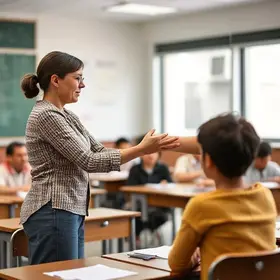
Imagine your child is in a large high school class of 30-35 students. She's not good at math. Most of the students in her class don't understand math and could care less about it. So your daughter hangs out in the back of the class, keeps quiet and tries to pay attention. The distractions and cutting up going on around her mitigate against any meaningful learning. Your daughter falls further and further behind in math. Sadly, public school class sizes continue to increase in many districts as schools struggle with staffing shortages and budget pressures in 2026. Class sizes of 30-35 students remain common in many public high schools.

Contrast that learning environment with 12-14 students seated around a Harkness Table in a boarding school. A Harkness Table is an oval table. The teacher sits at the table with his students. Immediately students are placed in a situation where they have no choice but to engage and interact with each other and with their teacher. A Harkness table creates a climate for learning.

Implicit in the small teaching groups is a climate of tolerance. The views of each individual are expressed. Critical thinking skills are practiced and polished precisely because the small group allows time for that. Large groups make

. . .read more

5 More Founders and the Schools Their Gifts Established

Updated
|
5 More Founders and the Schools Their Gifts Established
Vision. Generosity. High-minded principles. These are the hallmarks of the benefactors of the five schools featured in this article.

In this article, we examine five more remarkable private schools established with a vision supported by munificence. The Phillips Family, which established the Phillips Academies at Exeter and Andover in the 18th century, had the purest motives in mind. They understood that a well-educated citizenry would ensure the future of the very young United States of America.

"Above all, it is expected that the attention of instructors to the disposition of the minds and morals of the youth under their charge will exceed every other care, well considering that though goodness without knowledge is weak and feeble, yet knowledge without goodness is dangerous, and that both united form the noblest character, and lay the surest foundation of usefulness to mankind." Echols, Edward (1970). The Phillips Exeter Academy, A Pictorial History" Exeter Press

What was taught in these early schools? Remember that there were no schools in America when the colonists arrived. As a result, the early settlers did not have to follow traditions or laws governing their children's education. Since freedom from religious oppression was why so many colonists had left England, they ensured their religious teachings were the core of their academic curricula. Also on the list of subjects were useful skills such as simple arithmetic and spelling. Schools ran year-round.

Milton Hershey and Stephen Girard founded their schools at a different time in our nation's maturation. The industrial revolution had worked its wonders in the 19th century. But it has also created some social issues

. . .read more

Why Boarding School? It's All About Standards

Updated
|
Why Boarding School? It's All About Standards
Discover why experienced teachers are choosing boarding schools in 2026, from small classes and academic freedom to AI innovation and student mentorship.

I just read another one of those discouraging articles in the New York Times about the low esteem in which America holds its teachers in the 21st century. Author Sam Dillon was referring to public school teachers. While the circumstances have changed since that article was published, educators continue to face significant challenges. Teacher shortages, recruitment difficulties, increasing administrative responsibilities, and evolving educational expectations remain pressing concerns across the United States.

According to reporting from Education Week and research published by UNESCO, schools worldwide continue to grapple with teacher recruitment and retention challenges. At the same time, boarding schools continue to attract talented educators who are looking for opportunities to teach in environments that value academic excellence, meaningful student relationships, and professional growth.

Besides being able to have a job in their chosen profession, why else would professional teachers want to teach in a boarding school? They would want to do so for many of the same reasons why you and I want our children to attend such residential schools. Let's look at some of the factors which might make an experienced public school teacher consider teaching in the private K-12 sector.

Academic Standards

Teachers want to teach. They love their subject. They know it inside and out at the level at which they have been teaching. They know all the tricks and ways to light our children's academic fires.

Children are born curious. As they mature, we can nurture that curiosity,

. . .read more

Parents' Biggest Worries About Boarding School

Updated
|
Parents' Biggest Worries About Boarding School
Learn how boarding schools address safety, academics, college counseling, and student life concerns for families in 2026.

One of our parental prerogatives is to worry about our children. That's probably because your child never came with an instruction manual and, as a result, you have had to learn so many things about parenting simply by being a parent. No matter, worry is part of the parental landscape. Now, if you are thinking about sending your child off to boarding school, your worries will be quite specific. Probably along the lines of the following questions.

Many parents find the concept of sending a child to boarding school upsetting; a child's adolescence is such a distinctively affective period that entrusting it to others seems wrong. Yet boarding schools prosper, successors to institutions dating to medieval times.

In 2026, those worries are still understandable. Families are asking not only about academics and college placement, but also about safety, mental health, residential supervision, social adjustment, and cost. The good news is that today’s boarding schools are built around structure, accountability, and close adult guidance.

Will My Child Be Safe?

Boarding schools take your child's safety very seriously. Contractually, a boarding school functions in loco parentis, which is a legal way of stating that the school acts in the place of the parent when it comes to supervision of its students, your child included.

In many respects, your child is a whole lot safer at school, where she cannot drive or go to somebody's house and get into who-knows-what. Drugs, drinking, and smoking are not permitted in a boarding school. Zero tolerance is the rule. Does

. . .read more

Recruitment Fairs

Updated
|
Recruitment Fairs
North American boarding schools regularly send admissions staff overseas to hold recruitment fairs in your area.

Recruitment fairs are events held in locations all over the world that are meant to help boarding schools with their Recruitment of International Students. For example, Linden Educational Services holds Recruitment Fairs in both the Fall and Spring from locations such as East Asia, Latin America, Central Asia, Africa, and Europe. It's been doing this for 9 years. Aimed at parents and students who live in locations all around the world, these recruitment fairs put admissions staff from dozens of boarding schools on location in various International cities. You can meet school representatives and ask all the questions you have about American, Canadian, UK, and Swiss boarding schools.


Why would students from overseas consider attending boarding school in the States?

There are many reasons. As a rule, the main one is that parents want their children to have a world-class education. An International boarding school education will strengthen your child's language skills. Not just English, though it is pretty much the lingua franca in the business and professional world today, your child will also be able to learn a host of other languages, including French, German, Italian, Spanish, and Chinese, to name a few. International boarding schools generally offer a rich array of courses in many subjects. As you meet with school representatives, have a list of questions handy so that you will remember to ask about matters pertaining to curriculum.

Boarding schools also offer superb preparation for tertiary or college-level studies. While most boarding schools will follow the American

. . .read more

Recent Articles

What Happens During School Breaks for Boarding Students Who Stay on Campus
Learn what happens during school breaks for boarding students who remain on campus, including housing, meals, activities, supervision, and support services.
A Day in the Life of a Dorm Parent: Inside Residential Faculty Life
A day in the life of a dorm parent: how residential faculty support, mentor, supervise, and guide students while building community and shaping the boarding school experience.
How Boarding Schools Assign Dorms, Advisors & Schedules
Learn how boarding schools assign dorm rooms, faculty advisors, and class schedules, and what families should expect before move-in day.